How Prime Uses FleetVision™ to Strengthen Safety Culture Across Its Fleet

Prime Tanker Management operates oil product tankers worldwide, working primarily with oil major companies. Safety, technical performance, and operational reliability are central to how the company manages its fleet. Prime partnered with ShipIn to strengthen visibility into onboard safety behavior, reinforce standards with crews, and support a more consistent safety culture across vessels.
THE CHALLENGE
Maintaining consistent safety standards across daily vessel operations
Prime has strong safety procedures, audits, inspections, safety meetings, near-miss reporting, and vessel attendances in place. These activities provided important oversight, but they offered snapshots of safety performance at specific points in time. Prime wanted to complement these existing activities with continuous visibility between them, rather than replace them.
The challenge was consistency. Safety culture onboard depends heavily on Masters, Chief Engineers, and crews, who often come from different backgrounds, training environments, and safety cultures. As Prime grew, maintaining a uniform standard across vessels became more difficult, particularly in critical locations such as the bridge, engine control room, mooring stations, and deck.
Prime needed a more continuous view of how safety practices were being followed day to day. The goal was to identify emerging unsafe behaviors, understand where they were becoming normalized, and help Masters and shore teams focus coaching before they increased operational risk.
THE SOLUTION
Making safety behavior visible and actionable
ShipIn helped Prime turn onboard safety behavior into measurable operational insight. FleetVision gave Prime continuous visibility across the areas where safety behaviors matter most, including the bridge, engine room, deck, and mooring stations.
The system helped surface issues such as PPE gaps, missing hard hats and safety goggles, bridge watchkeeping concerns, unattended bridge events, and lapses in lookout practices. These issues can appear minor in isolation, but Prime viewed them as contributors to operational risk when they go unseen or uncorrected.
FleetVision also changed how Prime approached safety follow-up. Alerts were visible to both ship and shore teams, but Prime intentionally positioned the system as a leadership tool for the Master, rather than a compliance or disciplinary system. The Master remained the primary person accountable on board, reviewing alerts and addressing them with the crew through safety meetings, toolbox talks, and direct follow-up.
This gave Masters a practical way to engage crews in constructive safety discussions, reinforce positive behaviors, and support continuous improvement onboard. FleetVision provided an objective starting point for these conversations while keeping leadership and accountability within the vessel’s chain of command, helping drive crew acceptance. Introduced as a tool to support Masters and crews in maintaining high safety standards every day, FleetVision offers timely visibility into onboard activities, enabling vessel teams to identify opportunities for improvement, reinforce positive behaviors, and take ownership of safety performance onboard.
RESULTS
Turning visibility into safer behavior
FleetVision helped Prime translate visibility into measurable safety improvements. Over a 60-day comparison, PPE anomalies fell 76%. This was especially meaningful because hard-hat use in the engine room had been a long-standing challenge, yet Prime achieved significant improvement in a relatively short period.
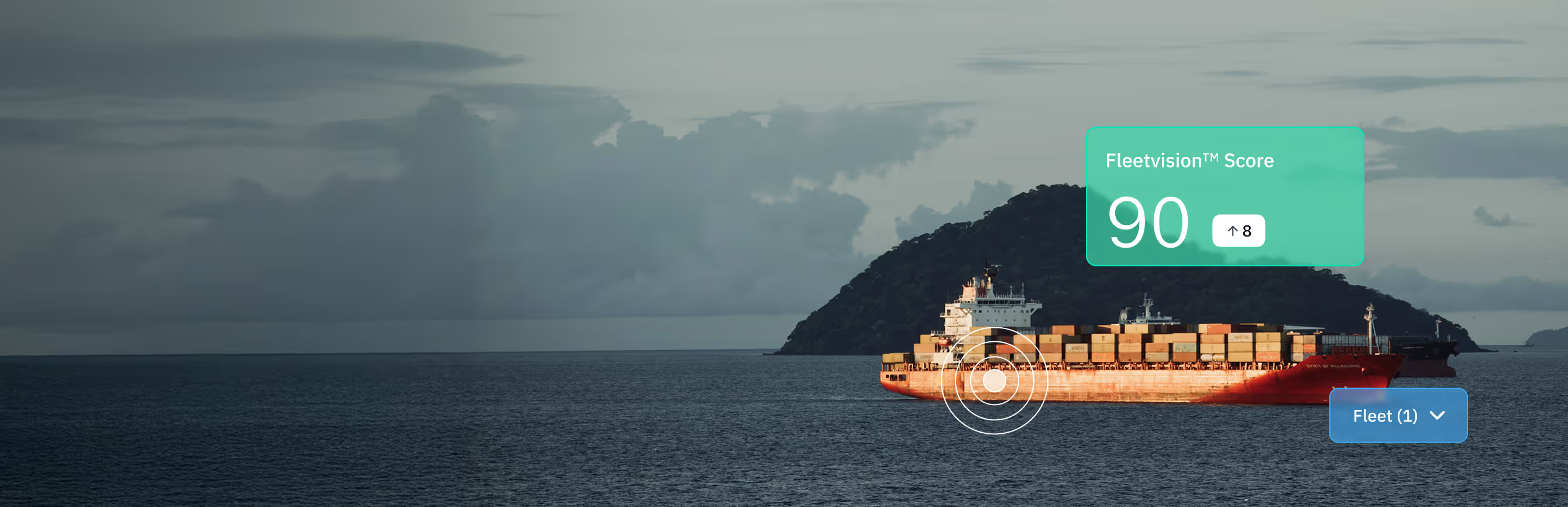
Safety engagement increased at the same time. Drills, toolbox talks, pre-shift meetings, and debriefs rose 3.4x, from 11 to 38, as Masters used FleetVision alerts to create more focused crew conversations. Prime also saw improvement across other operating areas. Bridge anomalies fell 51%, including watch-level and unattended-bridge events, while technical anomalies fell 69%. Over the same period, the overall FleetVision score rose from 82 to 94, placing Prime among the top-performing quartile of vessels using FleetVision.
FleetVision helped Prime align safety reporting with observed activity. Near-miss and hazardous occurrence reports could be compared with FleetVision alerts from the same operational areas. When reporting and observed behavior aligned, Prime had greater confidence that its safety culture was moving in the right direction. Where gaps appeared, teams had a clearer basis for follow-up.
The impact was also evident during external reviews. During TMSA audits, Prime used FleetVision to demonstrate how it identifies safety behaviors, supports continuous improvement, and reinforces operational standards with evidence. FleetVision was discussed positively during audits with Oil Major Companies. For an operator working closely with oil major customers, these discussions provided a tangible way to demonstrate the maturity of its safety program.
{{COMPONENT_QUOTE}}
LOOKING AHEAD
As Prime continues to use FleetVision across its fleet, the focus will remain on embedding safer behavior within the chain of command. By giving Masters a practical tool to identify and address safety behaviors earlier, Prime can reinforce standards more consistently across vessels and crews.
Looking ahead, Prime is focused on building on the progress already achieved. Continued improvements in PPE compliance, bridge watchkeeping, and crew safety engagement will help strengthen operational performance, while greater visibility into daily onboard activities will support earlier intervention and more proactive risk management.