Fewer Deaths, More Injuries: Why Maritime Safety Needs to Move From Paper to Real Time

Fewer Maritime Deaths do not Tell the Whole Story
Two safety reports published the last couple of weeks highlight an important gap in maritime. They cover different fleets and use different definitions, but both show why progress on the most severe casualties must be considered alongside the injuries people continue to suffer.
A falling death toll does not, on its own, tell an operator whether everyday work is becoming safer.
The Republic of the Marshall Islands (RMI) Maritime Administrator, responsible for one of the world's largest and youngest fleet registries, recorded a 33% reduction in very serious marine casualties in 2025. Yet serious injuries accounted for37% of all its marine casualties. The European Maritime Safety Agency (EMSA) recorded 29 lives lost in 2025, the lowest in a decade. Yet 813 people were injured, and that figure has stayed above 800 every year since 2023.
The gains in fatalities are real and hard-won. But the injury figures show why falling fatalities alone are not enough to judge progress.
Building on those gains needs real-time visibility of the warning signs, so crews and supervisors can step in before an incident happens. These reports give operators a starting point for deciding where to focus that attention.
Where Safeguards Need Support
The two datasets cover a large share of world shipping. The Marshall Islands is the world's third-largest flag, with 12.5% of global deadweight capacity [1] and close to 200 million gross tonnes [2]. Its fleet averages just under 11 years old [3]. EMSA's data covers EU and EEA flagged ships, about 15% of world gross tonnage [4], plus any ship in EU waters or with a substantial EU interest [5].
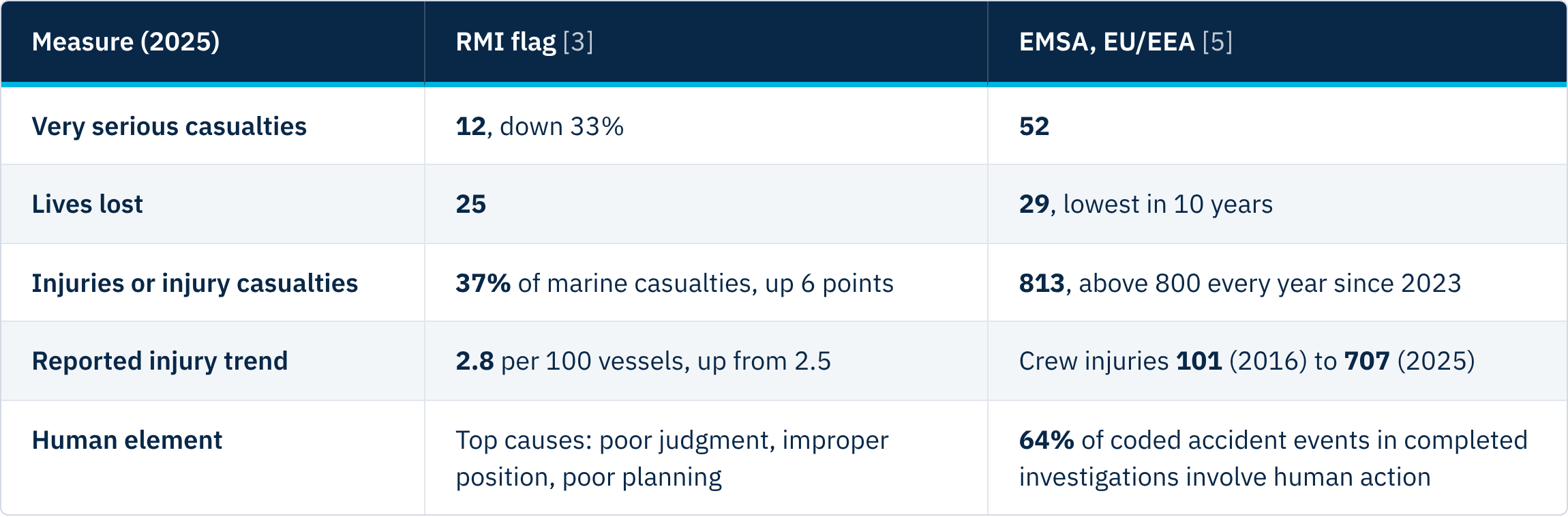
The detail matters more than the totals. In the RMI fleet, 31% of serious injuries happen in machinery spaces and 24% on the main deck. Crushing and pinching injuries are the largest group (23%). Injuries peak between 13:00 and 16:00, and engine-room fires cluster around the 04:00 watch handover [3]. EMSA finds that ships under 10 years old have the highest injury rate, at 31.1 per 100 ships involved [5].
In other words, a young, well-built fleet does not stop people getting hurt. The injury patterns give teams a starting point for reviewing daily work, alongside how often tasks are performed and how many people are exposed.
The Gap Between Procedure and Practice
RMI's fatal-case summaries describe a bosun whose lifeline was attached to the scaffold he was standing on rather than to the ship, and a seafarer working over the side without a harness. The lessons include effective supervision, correct use of fall protection and consistent application of safe-work procedures [1].
These were gaps between the safety management system and the work on deck. Closing them means understanding work planning, equipment, supervision and the conditions crews faced.
The research explains why paper and audits rarely close that gap. Størkersen calls it "auditism": organisations build what can be audited, while real work carries on outside the documented system [6]. A 2026 study of maritime SMS audits by Kim and Lee found that certification audits mostly check whether procedures are written down, not whether risks are controlled in practice. Audits become tools for assigning accountability after an accident, rather than preventing one [7]. The Maritime NZ v Gibson case, in which a port CEO was convicted over a fatality, raises the same concern: as Hutchinson reads the judgment, audits that check documentation can give comfort that a system works when they only show it looks sound on paper [8].
The regulators' own learning loop is slow too. EMSA investigates 83% of very serious casualties but only 2% of marine casualties, and 34% of its safety recommendations received no reply [5]. Learning that arrives a year after the event, for a fraction of events, cannot keep pace with what happens on deck every shift.
Process industries reached this point years ago. Khan and colleagues argued in 2016 that static risk assessment cannot keep up with complex, changing operations. They set out dynamic risk management as the next generation of safety management [9]. A 2022 review describes dynamic risk analysis as updating risk in near real time as conditions change, so decisions are based on what is happening now [10].
From managing safety records to managing risk as it happens
Dynamic risk reduction applies the same idea at sea. Instead of finding out after an audit or an investigation, the ship and the office see the warning signs while they can still be acted on. A missing harness can be corrected before the climb. An empty bridge can be manned before the close-quarters situation.
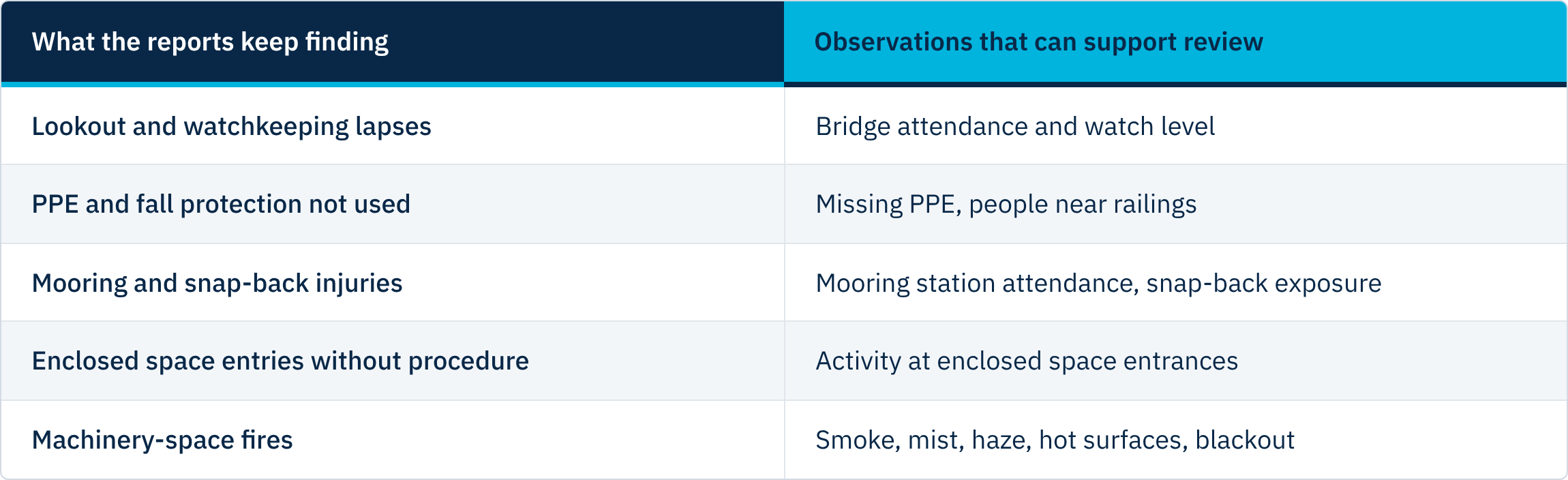
The value is not any single alert. It is a fleet-wide, continuous picture of how work is actually done in monitored areas. Those observations can add leading indicators to the injury counts and other measures used to assess safety [11].
What happens when the risk becomes visible
The Maritime Risk Report 2026, published by ShipIn and NorthStandard, gives a first view of this at fleet scale [12]:
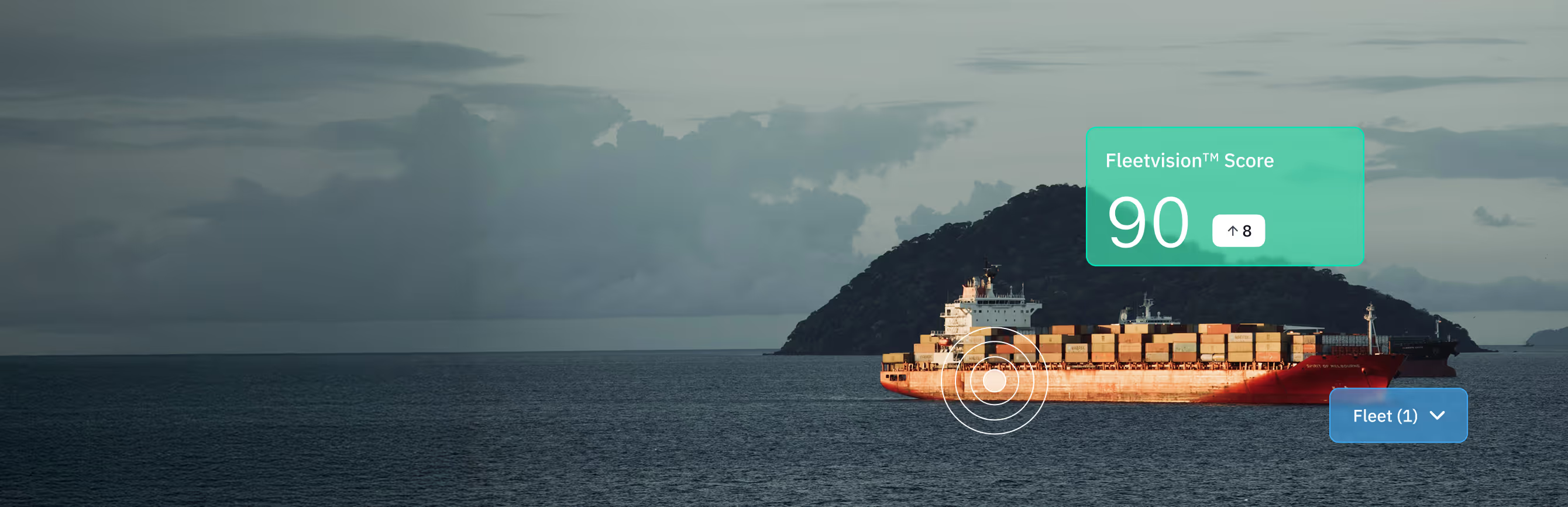
- Risk is concentrated. About 29% of vessels generated 70% of reported accidents. Vessels with a FleetVision score below 75 had 5.7 times the accident rate of those above 85.
- Visibility changes behaviour. Across 250 vessels tracked for 12 months, deviations on the bridge, on deck and in PPE fell from about 230 per vessel per month to 8, a 96% reduction.
- The fix is often a conversation. One tanker logged 150 bridge deviations in three months, 24 times the fleet benchmark, mostly unattended bridge at anchor. After the office reviewed the data with the Master, they fell to zero within two months.
What it means
For owners, injuries are the cost line that is not falling. Crew claims, off-hire, deviations for medical evacuation and vetting findings all follow from them. Seeing risk while it can still be acted on protects people first, then the balance sheet and the P&I record.
For operators, it changes the job of the HSEQ team and the Master. Less time proving that procedures exist, more time making sure they are followed. Attention goes to the vessels and shifts that need it, not spread evenly across the fleet.
For the industry, the goal is bigger than any metric: fewer people hurt, and every seafarer home safe at the end of their contract. Most companies already hold this as a value, and ShipIn holds it too, as a Public Benefit Corporation. It belongs at the heart of how a company operates, not only in its ESG or CSR report. Seeing how work is actually done lets the frontline own the process and prevent risk before it becomes an incident.
Empower safety, don't just record it
The falling death toll shows that the industry can improve when it commits. Persistent injuries show where further attention is needed. Records, audits and annual statistics remain essential, but crews also need timely information about what is happening now.
The next step is to empower crews to manage risk as it happens. Start with one recurring exposure, agree who will act on it, and check whether the response works. What one crew learns can help the whole fleet improve.
Sources
- UNCTAD, Review of Maritime Transport, flag shares by deadweight tonnage as of 1 January 2025, as reported by World Ports.
- Lloyd's List flag ranking, data as of 1 November 2025, as reported by Master Mariners Australia.
- Republic of the Marshall Islands Maritime Administrator, Annual Report on Marine Safety Investigations 2025, published 25 September 2026. Investigation reports.
- EMSA, The EU Maritime Profile: the maritime cluster in the EU.
- EMSA (2026), Annual Overview of Marine Casualties and Incidents, 2026 Edition, Lisbon. doi:10.2808/0718318.
- Størkersen, K. V. (2024). Auditism: Symptoms, Safety Consequences, Causes, and Cure. In The Regulator–Regulatee Relationship in High-Hazard Industry Sectors. Springer. doi:10.1007/978-3-031-49570-0_9.
- Kim, I., & Lee, S. (2026). Limitations of safety management system implementation and the transformation of certification audits for marine accident prevention. Journal of International Maritime Safety, Environmental Affairs, and Shipping. doi:10.1080/25725084.2026.2684072.
- Maritime New Zealand v Gibson [2024] NZDC 27975 (District Court, Auckland); conviction upheld in Gibson v Maritime New Zealand [2026] NZHC 813 (judgment). Commentary: Hutchinson, B. (2025). Ineffective audits and systems and false safety: Maritime NZ legal case. SafetyInsights.org, 23 May 2025.
- Khan, F., Hashemi, S. J., Paltrinieri, N., Amyotte, P., Cozzani, V., & Reniers, G. (2016). Dynamic risk management: a contemporary approach to process safety management. Current Opinion in Chemical Engineering, 14, 9–17. doi:10.1016/j.coche.2016.07.006.
- Raveendran, A., Renjith, V. R., & Madhu, G. (2022). A comprehensive review on dynamic risk analysis methodologies. Journal of Loss Prevention in the Process Industries, 76, 104734. doi:10.1016/j.jlp.2022.104734.
- Erkal, E. D. O., Hallowell, M. R., & Bhandari, S. (2023). Formal evaluation of construction safety performance metrics and a case for a balanced approach. Journal of Safety Research, 85, 380–390. doi:10.1016/j.jsr.2023.04.005.
- ShipIn Systems and NorthStandard (2026), The Maritime Risk Report 2026.