How AI Can Simplify the Marine Insurance Claims Process
.webp)
Understanding the Rise in Maritime Insurance Claims Post-Pandemic
The rise in maritime claims throughout 2022 was bad news for insurers, but hardly a surprise as increased shipping activity following the COVID-19 pandemic led to more incidents onboard. The rising costs of claims also contributed, with inflation pushing up steel prices and creating higher charges for ship spares and labor.
Factors Contributing to Increased Claims and Costs
Fire was another factor, according to an Alliance Global Corporate & Specialty report. The research attributed the cause of most blazes to mis-declared or non-declaration of dangerous cargoes onboard containerships. Elsewhere, the increased size of vessels – which have expanded by almost 1,500% in the past 50 years – creating an additional challenge.
Challenges Posed by Larger Vessels and Crew Workloads
The general rule is that bigger vessels lead to increased risks – and bigger losses for both the insurer and shipowner following an incident. Meanwhile, crewmembers are struggling to deal with an ever-increasing workload on cargo ships that are significantly bigger than they were several decades ago, increasing the risk of an incident and potentially contributing to the rising backlog in claims reporting.
Smaller Marine Insurance Claims Waste Time
Data from the Nordic Association of Marine Insurers shows that the costliest 1% of all claims account for at least 30% of the value of total claims in any given year. But, surprisingly, it’s the lower-value, higher-volume claims, worth around US$40,000 on average, that insurers spend most of their time on. As such, tackling these is key to improving marine insurance companies’ profitability.
Importance of Tackling High-Volume, Low-Value Claims
The question is, how? Whether faced with potential billion-dollar claims or a deluge of resource- intensive low-value attritional claims, insurers can use technology to help reduce losses and improve processes.
Transforming Marine Insurance with AI Technology
Technology is reshaping the mainstream insurance industry and filtering down to specialist segments within the sector, including marine. Shipping and insurance are undergoing a digital transition, with leaders in both markets recognizing that data-driven insights hold the key to significantly de-risking operations, driving efficiencies and mutually boosting commercial performance.
Reducing the Risk of Incidents Using AI-powered Insights
Establishing why a navigational incident happened is often difficult because many ships have limited contact with shoreside teams once they leave port. With limited visibility into ship operations, it’s impossible to know what occurred on board when a vessel is involved in a major incident such as a fire, piracy attack, or sinking.
Enhancing Claim Processing with AI-enabled Visual Data
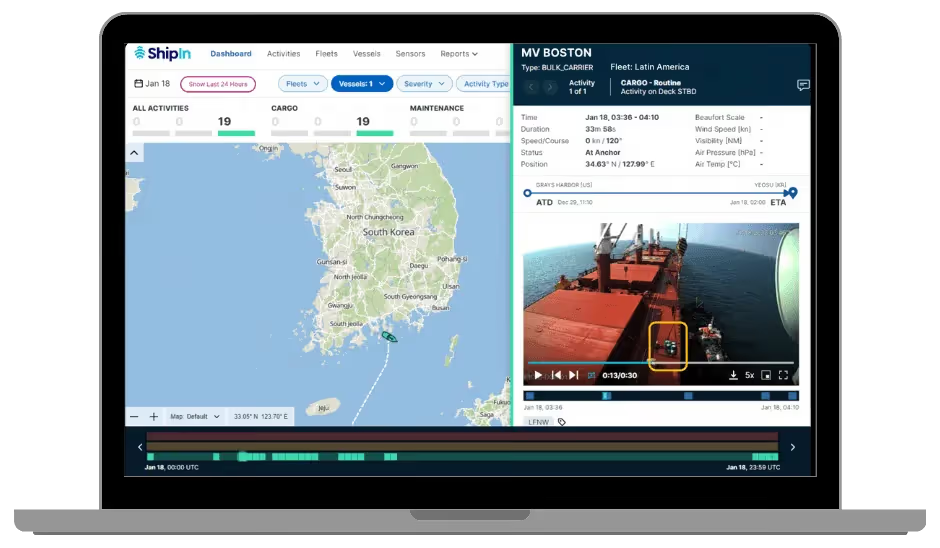
By using an AI-powered platform that plugs into a vessel’s CCTV, footage of such incidents can be retrieved in near real-time to identify the cause, negating the reliance on witness testimonies. The quality and visual aspect of this evidence allows insurers to close claims faster, and to challenge the validity of claims. This, in turn, reduces the time and the costs associated with a claim including the input of loss adjusters and lawyers.
Unlike traditional maritime CCTV, an AI-powered analytics system like our FleetVision™ platform provides immediate, real-time visual data. It creates intelligence that teams can use immediately to shape safety protocols and onboard behavior. This also eradicates the need to sift through 10,000 hours of footage for every vessel each month to determine retroactively what happened on board following an incident.
Role of AI in Loss Prevention and Operational Safety
AI-powered maritime CCTV also supports loss prevention by identifying any potential maintenance or safety risks related to piloting, security, and cargo handling. It monitors onboard operations, alerting the crew and shoreside fleet managers to issues that require attention.
Promoting Transparent Data Sharing for Symbiotic Benefits
Sharing data insights is a win-win for insurers, brokers, and ship owners, but it requires a level of transparency that is still uncomfortable for many. To really tap the advantages, ship operators and their crew need to build their confidence in the merits of sharing ‘warts and all’ evidence. In response, insurers should support this by rewarding companies that take such measures to prevent losses and incidents. Doing so has the potential to create symbiotic benefits that contribute to broad improvements in efficiency, profitability, and a safer seafaring culture.